
 HSDC co-lab collaboration
HSDC co-lab is a collaboration between members of the HandShake project (NZ) and Dialogue Collective (UK)
These two groups teamed up in 2016 and over the years collaborated in a variety of settings and focusses. In 2021 HSDC collaborated with TempContemp from Melbourne.

HSDC co-lab collaboration (featuring TempContemp)
HSDC colab is a collaboration between members of the HandShake project (NZ) and Dialogue Collective (UK)
These two groups teamed up in 2016 and over the years collaborated in a variety of settings and focusses. In 2021 HSDC collaborated with TempContemp from Melbourne.
 HSDC co-lab first cooperation was during lockdown with big size posters in the Melbourne CBD with the topic of CONTAINMENT- UNCONTAINED, This has set the tone for 2 more co-lab versions with Temp-Contemp:
 CONTAINMENT / UNCONTAINED- jewellery & image & text –
Refinery ArtSpace, Nelson, NZ
11 April – 6 May 2023 during NJW 2023
HSDCTC co-lab (version 3)
HSDCTC co-lab collaboration

CONTAINMENT / UNCONTAINED - working across borders (version 2) at Pah Homestead, Auckland (2022)

CONTAINMENT - UNCONTAINED (version 1) at Radiant Pavilion, Melbourne (2021)

Te Ao Hurihuri – Ever Changing World at the Crypt gallery. London (2018)

“It Will All Come Out In The Wash”, at Lot62, MJW, Munich (MJW, 2017)

SAME time, different PLACE, online mini challenge (2016)

HSDC HISTORY
Early 2017 jewellery artists from Aotearoa New Zealand’s Handshake Project and the UK-based group Dialogue Collective decided to collaborate.
To improve knowing each other, they started off with a mini online challenge: ‘same-time–different-place’. In March 2017 they exhibited during Munich Jewellery Week with their first collaboration called It Will All Come Out in The Wash.
On the back of that success a group from Handshake collaborated with Dialogue Collective again in 2018 with the exhibition ‘Te Ao Hurihuri’, held at the Crypt Gallery in London’s Kings Cross.
2020 was going to be the year that Dialogue Collective would visit New Zealand to exhibit the third and final collaboration with Handshake. But Covid stopped all of that …
The project’s trajectory to date embodies the challenges of working across borders and within the constrains of time. Their community during a global pandemic found ways to collaborate. So, using the virtual world as a means of collaboration as well as exhibiting the teamwork kicked off with a mutual journey on Instagram, resulting into a theme of restricted containment that sums up the new normal both artists’ groups endure during the global pandemic.
In September 2021 they developed HSDC Co-lab for the ‘Radiant Pavilion’ event,
Artworks related to Containment - Uncontained in the format of wall posters were found during their lockdown in the streets of Melbourne. HSDC invited Melbourne, AU. HSDC colab teamed up with the collective TempContemp to establish a New Zealand, United Kingdom and Australian collaboration with a new name: HSDCTC colab collaboration.
This online zine with each artist work.
See how their journey unfolds
#handshakeproject #dialoguecollective #hsdccolab #contemporaryjewellery
story:
What started the HandShakers off as contemporary jewellers.
See portfolio samples below:
story:
What started the Handshakers off as contemporary jewellers.
See portfolio samples below:
Mandy Flood

First image ‘Just the Packaging’ 2017. The piece of work that I can truly say I am at ease with and proud of.

Image 2. I have always been intrigued by how things come together. The ‘ Haines Car Manual’ was often referred to when I was the proud owner of a Ford Fiesta. As a result of following instructions. I changed breaks and oil filters along with wheels and bulbs.

Image 3. Just one of many holiday snaps. It was on a street in Shanghai last year. This is what inspires my making.

Image 4. ‘Slick Blue’ 2009 Silver glass paint.Helen Britton. When I discovered Brittons work in 2010, I felt the most amazing happiness! It wasn’t just me who saw wearability in everyday things. At that point I realised it was possible to forge forward with my passion. Thank You Helen.
 Image 5. Christine Graf ‘Motion’ 2011
How to do enamel! I have a lot to explore.

Image 6 Helen Britton ‘Coldland’ 2009 Paint and silver and diamonds. This further confirmed how ‘precious’ materials can be treated. This irreverence to perceived value I adore.

Image 7. Image of the install for ‘Metadecorative’ Mary Curtis 2010 Objectspace Auckland.
This install has always stayed with me.

Image 8. Reverse of a Necklace in the Metadcorative Exhibition @mary.curtis 2010.
When the back is equally wonderful as the front.
During my degree I found a word ‘Rhopography’ This word was coined by art historian, Norman Bryson. It’s definition is ‘Those things that lack importance, the unassuming material base of life that importance constantly overlooks’.
This is how I approach my journey in contemporary jewellery.
Thanks to;
@helenbrittonartist @volkeratrops @iriseichenberg @christine_graf_enamel
@raewynwalsh @handshake_project & Alan Preston
Kelly McDonald

Growing up in a small Australian town, my first school trip to the city made a big impression. I saw Victorian bushranger Ned Kelly’s homemade armour (from 1880) at the State Library of Victoria. It sparked my long obsession with the rectangular aperture or eye hole of the helmet. Image: Chensiyuan
 Sidney Nolan’s Ned Kelly painting series further fuelled my obsession – in particular, the immediacy, simplicity and freedom of his narrative. Holes draw the eye into the work, while for me they also act as eyes, as a comment on both looking and seeing and the possible disparities between the two. Sidney Nolan ‘Kelly’, 1954. Image: Britannica.com

In 1995 I went to a University open day and met jewellery and object tutor Mark Edgoose. He realised I had no idea about what I was trying to sign myself up for and sent me along to his tableware exhibition. Game on! I’d never seen anything like it and I immediately moved to Sydney to begin my jewellery studies. Container, 'Two-stack', Mark Edgoose, 1995. Image: NGA

Margaret West was one of my tutors at Sydney College of the Arts. With an uncompromised commitment to excellence, regular snippets of her teaching still come to me at the bench 26 years later. Margaret West, ‘Auric Elegy’ 2004. Image: www.margaretwest.com.au.
 Pre internet, the SCA library offered me a portal to another world. I borrowed these two books monthly for 3 year straight. Devon-Karbon-Perm, 62 ausgewählte objekte 1984-87. Photographed by annelies Sˇ trba, Worn by daughter Sonja, 1988. Self-published, 500 copies printed. Found Treasures : Hermann Junger and the Art of Jewelry by Florian Hufnagl, Thames & Hudson, 2003.

For years I coveted this work of Tone Vigeland’s. I tried it on in Electrum in 1997 and saw it again at her Die Neue Sammlung retrospective in 2017. Image: DNS

Onno Boekhoudt was another early inspiration. During HandShake 5 project I had the privilege of dialoguing and making in response to Onno Boekhoudt’s work for exhibition at CODA. Carin Reinders, Director of the CODA Museum said his “artistic legacy is of great importance for all those interested in modern art, but I would like to single out one group in particular: art students. They can follow the tracks of his endless searches and discoveries without it necessarily having to result in a ‘find’. Onno Boekhoudt considered the investigations, the process, and his studies far more important than a possible end-result. That is an exceptional way of thinking and working.” p.10 of Onno Boekhoudt: Works in Progress.

My undergrad work made it to the front cover of Art & Australia. ‘Wrap – A Self Portrait’, Paper, wax, silk thread, 1997. Image: Andy Solo

Rebecca Ross Russell’s ‘Gender and Jewelry: A Feminist Analysis’, 2010 was integral to my Masters research. “Jewelry responds to our most primitive urges, for control, honor, and sex. it is inescapably political, its meaning bound to the possibilities of the body it lies on.”

‘DIY IUD’s’, Wall installation, brass, ceramic, silver, steel, gold, 2019. Made as part of my Masters study.
Kathryn Yeats

1. Fourth New Zealand Jewellery Biennale Grammar: Subjects & Objects catalogue
Dowse Art Museum. 2001. Curated by Deborah Crowe

The exhibition included works which told stories which resonated with me, and which weren't necessarily wearable like the exquisite piece The Herbal Mixture by Areta Wilkinson
2. Areta Wilkinson. The Herbal Mixture. 2000
Glass Bottles, Silver
 I particularly admired Andrea Daly's work.
3. Body Dirt, at once beautiful and repulsive, mixing precious materials and everyday trash, so fragile but speaking to solid sacred crafted objects.
Andrea Daly, Body Dirt. 2001
Hair, Depilatory wax, safety pins, sticking plasters, human blood, resin, gold leaf, fake pearls, thread mirror

4. I also love the fundamental engagement with the body in Daly's work Weight, Hip
Andrea Daly, Weight, Hip, Soapstone. 340x160x110. From Open Heart, Contemporary New Zealand Jewellery Catalogue.
Dowse Art Museum. 1994
Laurence Hall, Curator

I've also been fascinated with textiles and the handmade.
5. Therese De Dillmont
Encyclopedia of Needlework. First Published in 1886

7. Reverse of Doily
My favourite artist when I was a teenager, who I still greatly admire is Eva Hesse, her absurd objects, repetition and use of novel materials are compelling.

8. Eva Hesse, Contingent 1969
Cheesecloth, latex and fiberglass
350 x 630 x 109 cm
From: Elisabeth Sussman and Fred Wasserman
Eva Hesse Sculpture
Yale University Press (New Haven and London) 2006
Works from 2019 referencing women's health, the body, textiles and the handmade.

9. Kathryn Yeats, Hysterical
Silk, silk thread, ribbons, steel pins
195 x 85 x 40mm (plus ribbon ties)
Sleep Mask. 2019

10. Kathryn Yeats, All in her Head
Silk, silk thread, timber, sterling silver
80 x 55 x 40 mm
Brooch. 2019
I have never coveted the rows of shiny gold and silver jewellery and sparkly gemstones in high street jewellery stores. The first time I remember really being intrigued by jewellery was at the jewellery biennale at the Dowse Art Museum.
Nina van Duijnhoven

Workshop with Karl - Make 100 rings in 5 days

Workshop with Lisa - Collect stuff you would normally throw away and make jewellery with it
Workshop with Lisa - Collect stuff you would normally throw away and make jewellery with it
Workshop with Lisa - Collect stuff you would normally throw away and make jewellery with it
Workshop with Lisa - Collect stuff you would normally throw away and make jewellery with it
This is some of the work I made during workshops taught by Karl Fritsch and Lisa Walker during my first year at Whitireia. Initially I had enrolled for one year only to learn silversmithing techniques, not really having a clue about contemporary jewellery. It was these workshops, the making and the discussions at the end of each day, that changed everything for me. I discovered that my joy and strength lie in intuitive making. I was hooked and enrolled for the full study. I have never worked with metal since! Forever grateful to Karl and Lisa, it changed my life!
Nik Hanton

"Nocebo Effect", 2019. The NoceboEffect is a term used to describe the expectation of a negative outcome from a treatment and its detrimental effect on an individual's wellbeing. (Photo credit: Stanley Street Gallery)

(left) My first piece of jewellery at 1 day old used by the hospital to identify babies. I didn't much care for it.
(right) The first piece of jewellery I remember owning is an elasticated plastic bracelet, which I adored. The stethoscope suggests jewellery to me more now though!

(left) My first ever job at 17 was in a costume jewellery store, "Bijoux Moda". The glitzy gold and apple green interior was very 90s and, it would appear, I was too. The store stocked a range of jewellery by "boutique manufacturers" from around the world.
(right) I see that that colour still has an appeal to me: Be Still My Glow In The Dark Heart 2020, 100x70x50mm, PLA, brass.

I grew up with this A.P on the wall and it was true of the ethos of my family: "Art is my life". Philip Clairmont. 1980.
ARTISTS WHO INSPIRE:

Tanel Veenre -Big Trophy III, 2012, neckpiece, wood, silver, cosmic dust, 250 x 220 x 70 mm (Photo credit: Artist).

Lores Langendries -Once in a while everybody needs a new haircut, 2015, Roedeer hide, saddle leather and magnets. 5 x 5 x 2.5 cm © By the author (klimt02.net: 2019).

Vincent Pontillo-Verrastro: Gasconade brooch, 2015, PLA, horsehair, mink, graphite, rare earth magnets, 210 x 184 x 67mm
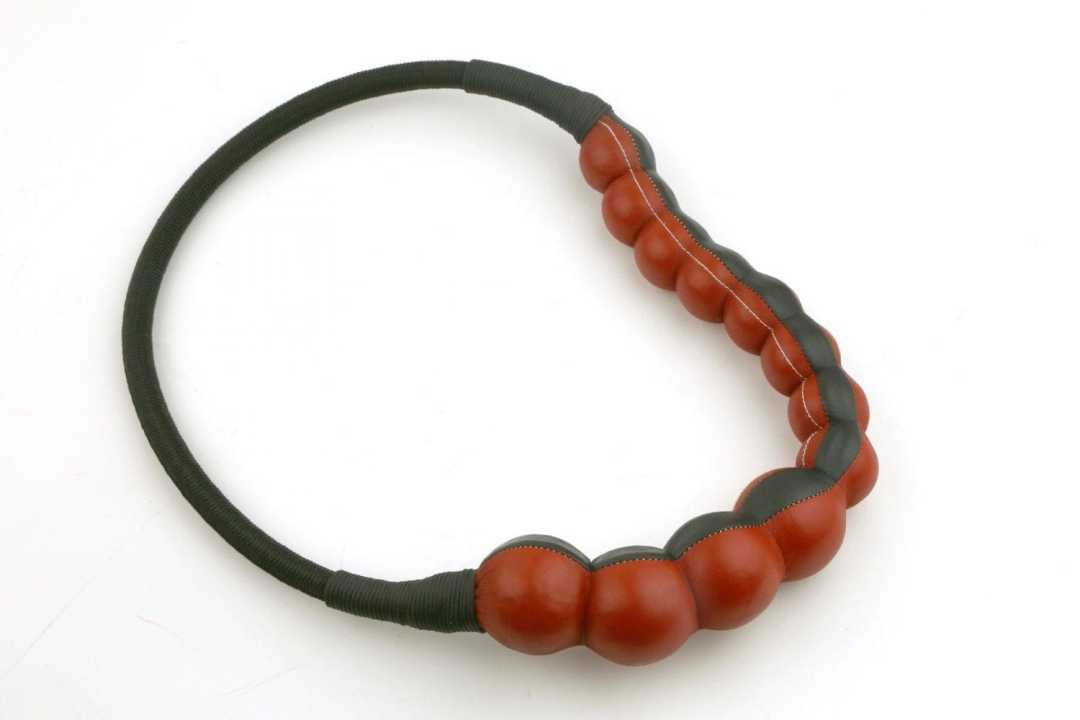
A piece from my first year at Whitireia under Peter Deckers + Kelly McDonald, "Kin", 2013, leather, textile, 270x250x50mm.

"Only the brave", 2020, PLA, 160x160x120mm.
The path...
The intersection of adornment and art is what drew me to #ContemporaryJewellery. I've always had a passionate interest in the visual arts, the humanities, and the way in which we express ourselves through our choice of WhatWePutOnOurBodies.
Contemporary Jewelry has been a way of combining these interests.
Sarah Read

Chain of Shame by Sarah Read, necklace from sweet wrappers, 2018 – 19

16th birthday gift from dad. He was an artist and an art teacher; my happiest childhood place was his studio. I grew up feeling like an artist, but blundered into IT after his early death. This brass pebble sits heavy in the hand; solace.

20 years on, new life in Aotearoa. My son napped better in the car so we’d drive out to hang with Barry Lett’s brick dogs at The Dowse. Here by chance I found NZ's burgeoning jewellery scene in a series of stellar shows which included Deep and the NZ jewellery biennials. Evening classes, artist talks and graduate shows steered me to enrol in Whitireia's jewellery programme; the dream team@peter_deckers/@h.gascard,#vivienatkinson@kellymcdonaldnz, and@matthewmcintyrewilsonblew my mind, and these landmark pieces sealed my fate:

Peter Deckers: Andy Warhol Signature Ring (for stamping soup cans in supermarkets ), Stg, rubber stretched US coin, inkpad. From the Reproduction Guild Installation, 2002

Otto Kunzli: Necklace, 48 Used Wedding Rings, 1985-6

Fran Allison: How to Make a necklace from a frock, 2005 Mixed materials. Image: Deb Smith

Iris Eichenberg: Two of the same kind keeping each other warm. Mixed media


I find my voice. Sarah Read: I really should get out more, 2008. Necklace exchange and double makeover. Sarah's necklace: poodle wool, felted. Frankie's necklace: Jersey pillings, felted.

Starting out is one thing; keeping on is quite another. Connecting with like-minded peers feels essential and I am grateful for my colleagues past and present in@thehandshakeproject@dialoguecollective@the.see.here@thejellyreading@tothepowerofthreeartand@occupation.artist(seen here), and of course,#jewellerywidower#handshakesurvivorand all-round Good Bloke@noelreadnz
It’s beyond ironic that my turn to post here should coincide with the closing event for Whitireia's jewellery school, the place that started me – and so many others - off as a contemporary jeweller. Dark days for art education, eh. Kia kaha, jewellers; be strong
Aphra Cheesman

I grew up in Auckland and Melbourne. My mum is interested in contemporary jewellery so as a teenager I would go with her to Fingers and Gallery Funaki to look at the exhibitions that were on - I always tried on the Karl Fritsch rings! Photo: Still trying on Karl Fritsch pieces over 10 years later. Taken at Gallery Funaki in 2019.

In 2012 I started a 3 week evening class in wax casting. I was so excited by the process and possibilities and haven’t stopped making since. Photo: the first piece of jewellery I ever made.

Moving back to Melbourne in 2013, I started a jewellery short course and it was recommended that I look at this book made alongside the then recent exhibition ‘Unexpected Pleasures’ at the NGV. Photo: Unexpected Pleasures, Ed. Susan Cohn is currently siting on the coffee table in my living room - I still look at it regularly!
Following four photos include artists, work and exhibitions I’ve been totally blown away by:

Lisa Walker: ‘I want to go to my bedroom but I can’t be bothered’, at Te Papa Tongarewa (2018) and Rmit Design Hub (2019) Photo credit: rmit design hub.

Minegishi/Britton/Bielander exhibition at Project Space 2017.

V&A jewellery room. One of many photos that I took at the V&A in 2012 around the time I started making jewellery.

Multiple Exposures exhibition at Museum of Art and Design. Also the MAD jewellery collection. An amazing experience seeing this collection early on in my jewellery making practice.

Undergraduate work. Switches, neckpiece, 2018. Photo credit Andrew Barcham.

Stuff Theory: Everyday Objects, Radical Materialism. Maurizia Boscagli. A key reference for my honours research project.

Stuff, 2020, installation view of my final honours’ degree presentation.